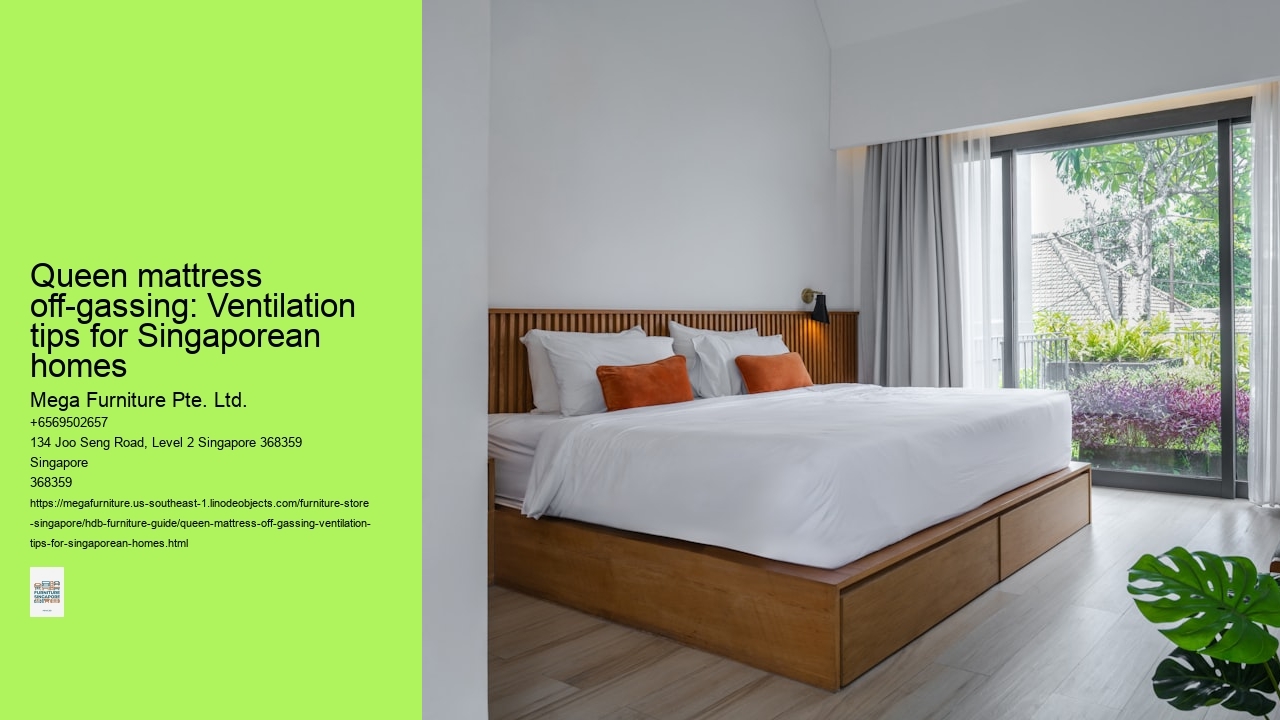
Picture a typical Friday evening in a 4-room BTO flat. The new Queen mattress arrives, you unroll it, and the master bedroom door closes. With the air-con humming and windows shut tight, you’re left with a distinct chemical tang hanging in the air. That’s off-gassing—the release of volatile compounds from the mattress’s foam and adhesives. In a compact 12 sqm room, common for many Singaporean master bedrooms, those fumes concentrate quickly. They don’t just linger; they can feel overwhelming, disrupting that first night’s sleep you were so looking forward to.
It’s a temporary process, usually fading within a week or two, but the intensity depends on the materials. Higher-density foams and certain adhesives tend to release more. The sealed environment of an HDB bedroom, especially during our humid months when you might keep windows closed to run the air-con, creates the perfect trap for these odours. The step up from a queen is a king size mattress at around 182 to 183cm wide — 30cm more room, but only worth it if the bedroom can take it. The honest test is the floor: if a king leaves no walking space on the sides, the queen is the smarter buy. A king suits a master bedroom of roughly 3.5 by 3m and up; below that, a queen sleeps a couple comfortably without crowding the room. For most flats, the queen wins on fit; the king is the upgrade for genuinely large rooms.. There’s no cross-ventilation to dilute them, so they just accumulate around the 152 by 190cm footprint of your new bed.
The straightforward fix is to open the windows wide for several hours after delivery, even if it means sacrificing some cool air. Run a fan to push the stale air out. Do this before you settle in for the night. Some buyers even leave the bedroom door open and the fan on overnight for the first few days, letting the living room act as a buffer zone. It’s a simple step, but one that’s often overlooked in the rush to get the room set up.
Ignore the smell and try to sleep through it? Cannot. It’s not just about comfort; prolonged exposure to concentrated VOCs in a small, sealed space isn’t ideal for anyone. The exception is if your flat layout allows for a different approach—say, if your master bedroom has a dedicated balcony door you can leave open. For most, though, in our typical enclosed rooms, proactive ventilation is the only sensible move. Plan for it as part of your delivery day, and you’ll avoid that unpleasant first-night surprise.
Before committing to a queen, the mattress sizes guide puts it in context — Single (91cm), Super Single (107cm), Queen (152cm), and King (around 183cm), all at 190cm length, plus how local sizes differ from overseas ones. It's the read that prevents the most common sizing mistake. Confirm the queen fits your room and matches your frame before buying, since even the popular middle size still has to clear the doorway and pair with the right base.. Queen is the size most Singapore couples land on, and for good reason: at 152 by 190cm a queen size mattress gives two people room to sleep without the king's footprint swallowing the master bedroom. It's the balance point — wider than a super single, 30cm narrower than a king, and the size most HDB and BTO master bedrooms are quietly built around. The local dimension is worth pinning down, since a queen isn't the same everywhere: the SG standard is 152 by 190cm, where a US queen runs longer at 203cm and a UK queen wider at 160cm, so an imported assumption can leave a mattress that doesn't match the frame. Beyond size, the choice is feel and construction — memory foam for contouring, latex or hybrid for cooler support, pocket spring for the motion isolation that keeps one partner's movement from waking the other. Get the size and the feel right and a queen is the most practical comfort upgrade most bedrooms can make.. " width="100%" height="480">Queen mattress off-gassing: Ventilation tips for Singaporean homesEast-side flats near Eunos MRT have a certain dampness you can feel. Humidity often sits around 80% plus, and that moisture hangs in the air, slowing everything down. This includes the off-gassing from a new mattress. Those chemical vapours need to evaporate, but damp air doesn't let them go quickly. So that faint factory smell lingers longer than you'd expect—sometimes for weeks instead of days.
It's a problem that compounds in certain bedroom layouts. Many resale flats, especially those with bedrooms tucked into corners, lack proper cross-ventilation. You might have only one window facing a narrow corridor between blocks, or a room that opens into an internal corridor instead of outside air. Without a good breeze to carry the vapours away, they just hang around the mattress surface, trapped in that humid microclimate. Opening that single window might not be enough to create a real flow.
Think about the materials, too. Foams and adhesives release their gases slower when the surrounding air is already saturated. It's like trying to dry a towel in a bathroom after a shower—the process just takes more time. In a dry, airy room, the odour phase passes relatively quickly. A queen bed sets the scale for the master bedroom, so everything else works around it — which is why it sits within the wider bedroom furniture range in Singapore , the wardrobe, the bedside tables, the chest of drawers that share the remaining floor. Because a queen leaves more walking space than a king, the surrounding pieces have a little more room to breathe. Keep the finishes loosely in agreement and a queen-anchored room reads calm and balanced even when fully furnished.. In a damp, still one, you're waiting. And if you've just moved into a flat and need to sleep there straight away, that wait can be uncomfortable.

The only real fix is to force the air to move. If your bedroom layout is poor, you'll need to help it. A standing fan placed to blow directly across the mattress surface, day and night for the first week, can mimic the cross-ventilation nature isn't providing. For the full breakdown, the queen mattress dimensions guide sets out the local standard — 152 by 190cm — and how it differs from the US (152 by 203cm) and UK/Europe (160 by 200cm), which is exactly the confusion that catches buyers out. It also notes some SG queens run longer at 198 or 203cm. The takeaway: confirm the local dimension and measure your frame before buying, since the gap between a 190cm and a 203cm queen is enough to leave a mattress hanging or short.. It pushes the humid air layer away and encourages evaporation. Some people even temporarily move the mattress to a more central, airy space like the living room for a few days if the master bedroom is particularly stagnant. It's an extra step, but for flats in those humid neighbourhoods, it's often the one that works.
The idea hinges on your bedroom layout. If your master bedroom's main window faces west, you've got a natural tool. That afternoon glare, the one that makes you draw the blinds by four, is precisely what you'll use. You don't need the whole bed bathed in light all day—just a deliberate, focused exposure. Position your new queen mattress so the sun's path crosses it for a limited, controlled window. This isn't about random placement; it's about aligning the bed with the geometry of your room and the sun's trajectory.
Duration is everything. A queen mattress needs a matching queen size bed frame built to the same 152cm width, so the two are best chosen together to sit flush with no gap at the edges. The frame sets the room's footprint, so measure for both the mattress and the frame's outer dimensions plus walking space. Leave around 60cm clearance on the side you climb out of. Pairing the mattress and frame in the same size avoids the mismatch of a queen mattress on a not-quite-queen base.. You're aiming for a short blast, typically an hour or two at the peak intensity. Set a reminder, because leaving it for the entire afternoon is a recipe for damage. The heat can degrade materials, especially certain foams or fabrics, if they're subjected to prolonged baking. Think of it like a quick, intense burst of ventilation energy rather than a slow roast. You'll want to monitor it closely, perhaps even setting up a temporary marker to know when to pull the bed back into shade.
Not all mattress types welcome this method. Memory foam and certain synthetic layers can become overly pliable or even warp under sustained heat. Natural latex is generally more resilient, but you still don't want to test its limits. The goal is to accelerate the release of those initial manufacturing volatiles, not to alter the core structure of the mattress itself. Always check the care instructions from the manufacturer—if they explicitly warn against heat exposure, you should skip this entire approach. It's a calculated risk for a specific benefit.
This method often finds its best application in condo units. They tend to have larger, cleaner west-facing windows without the obstructing balcony clutter of some HDB flats. The unimpeded light stream is more direct and easier to harness. In a typical 12–15 sqm master bedroom, manoeuvring a 152 by 190cm queen to catch that light is a straightforward spatial puzzle. You're using the architecture of your home—the big glass panels common in newer developments—as an active component in your setup routine. It turns a climatic challenge into a functional advantage.
You cannot just leave it and forget it. Establish a simple system: note the time the sun hits the mattress corner, and note when it should stop. Use a timer on your phone. Visually check the surface temperature—if it feels hot to the touch, it's probably too much. The off-gassing smell should diminish, not be replaced by a scorched odour. This isn't passive; it's an active, managed process that requires your presence for those key hours after delivery. Done correctly, it can shorten that new-mattress smell period significantly, letting you sleep on it sooner.
It’s tempting to just close the door and let the air-con run all night, especially in a master bedroom that’s already tight with a Queen mattress and wardrobe. But sealing the space completely means any off-gassing from new materials—not just the mattress, but sometimes the frame or even fresh paint—just sits there, circulating in the cooled air you’re breathing. You’re trading comfort for a stale chemical mix, and that’s not a win.
Instead, think of it as a cycle. Cool the room down for a solid stretch—say, the first half of your sleep. Then, in the early morning or even before you wake up, switch off the air-con and turn on a ceiling fan or standing fan at full blast. Open the bedroom door if you can, or crack a window. That forced ventilation pushes the accumulated air out and pulls fresh air in, diluting everything that’s been building up. It’s a simple reset.
The timing doesn’t need to be precise. In a queen, a memory foam mattress gives both sleepers contouring, pressure-relieving support and strong motion isolation, so across the shared width one person turning is barely felt by the other. Look for a cooling-gel or open-cell version, since foam can sleep warm in the local climate. For couples who value undisturbed, cradled sleep on a queen, memory foam is a natural choice — just weight the cooling features given Singapore's nights.. Some people programme it around their routine: air-con on from bedtime until 3am, then fan on from 3am until they rise. Others just make it a habit when they get up for water or to check on the kids. The key is creating that deliberate exchange. In a typical 12–15 sqm master bedroom, a good fan can shift the air volume in under thirty minutes.

There’s only one real exception. If you’re dealing with a severe allergy or asthma trigger where even brief exposure to outdoor air is a problem, then sealed cooling with a high-quality air purifier might be the safer path. But for most couples, that morning air flush makes a tangible difference—you’ll notice the room feels fresher, not just cooler. It’s a small habit that pays off in better sleep and a healthier space.
Opening windows for a week is the usual advice. But in a freshly renovated 3-room flat, where the master bedroom might have just one window facing a narrow corridor, that breeze won't cut it. The new Queen mattress, along with fresh paint and new cabinets, can release a concentrated mix of smells that linger in the limited air volume. You’ll know it’s not working when, after a few days, the room still feels stuffy and the faint chemical scent hasn’t dissipated.
Consider a professional service when allergies are a factor. For couples where one partner is sensitive, standard airing out isn't a precaution—it’s a necessity. An industrial-grade fan or a high-capacity air purifier rented for a weekend can forcibly cycle the entire room’s air volume, pulling those volatile organic compounds out faster than passive ventilation ever could. The cost is an investment against weeks of discomfort or worse, a reaction that disrupts sleep from day one.
The layout itself can be the deciding factor. Some BTO master bedrooms are designed with the bed wall opposite the window, creating a dead zone where air simply doesn’t flow. If your 152 by 190cm Queen is destined for such a spot, a portable fan placed by the door will just stir the same air. A professional setup uses directed, high-volume airflow to create a cross-current, effectively flushing the entire space from corner to corner. That’s something your standing fan can’t achieve.
There’s a counterintuitive point here: a smaller room actually benefits more from this intervention. In a 12 sqm space, every cubic metre of air gets saturated with off-gassing compounds quickly. A powerful system can purge and replace that entire volume multiple times over a weekend, resetting the air quality to a clean baseline. In a larger, well-ventilated room, natural diffusion does the job eventually. But in a compact one, you’re not waiting for eventual—you’re solving it now.
Skip it only if your bedroom has true cross-ventilation, with windows on opposite walls or a large opening to a well-ventilated living area. For most newly renovated HDB master bedrooms, that’s a luxury. For a cooler, more responsive queen, a latex mattress breathes better than traditional foam — its open structure keeps air moving, which matters on a shared queen surface in the tropics. Latex is durable, hypoallergenic, and supportive with a springier feel than memory foam. For a couple who run warm and want cool, breathable support across the full width of a queen, latex is the construction worth comparing first.. If your space is sealed and your health is priority, the weekend rental isn’t an extravagance—it’s the logical next step.
The showroom floor is where you'll decide if a Queen mattress can really last. Couples tend to assume firmness levels are just a number on a tag, but the real test is pressing your hand into the surface and feeling how the weave responds to humidity. Singapore's climate means a mattress fabric that feels cool and breathable in a controlled showroom might still trap heat in a Bedok flat during the first few weeks of off-gassing. That initial period, when new foam is settling and any faint smell dissipates, is when you'll notice if the material doesn't let air circulate properly.
You can't gauge breathability from a website photo. At the Joo Seng or Tampines showrooms, you get to sit on the edge, lie down fully, and feel how the fabric interacts with your skin after a minute or two. Does it stay dry, or does it start to feel clingy? A tight, smooth weave might look premium, but a looser, textured one often allows more airflow—something you'll appreciate during the year-end monsoon when everything feels damp. This hands-on check is the only way to predict whether you'll be comfortable during those initial nights, before the mattress fully acclimatises to your bedroom's environment.
Some buyers skip the showroom visit because they think a Queen mattress is a straightforward purchase. For couples especially, a pocket spring mattress is the queen construction that earns its keep — individually wrapped springs move independently, so one partner's tossing doesn't roll or wake the other across the shared width. It also breathes better than solid foam, the coils letting heat escape. Browsing by type shows how pocketed spring compares to foam and latex for a queen. For two sleepers who disturb each other easily, the motion isolation is the feature worth paying for.. That's a mistake. The difference between a medium-firm and a firm feel isn't just about support; it's about how the mattress material will perform under sustained use in a humid room. A fabric that feels slightly rough but cool in the showroom could be a better long-term choice than a silky one that turns warm quickly. You need to assess this yourself, because a couple's combined weight and sleeping patterns will stress the material in ways a single tester won't.
The one exception is if you're replacing an identical model you already know and love. In that case, you might order the same one again without a visit. But for any new purchase, especially for a master bedroom that two people will share every night, making the trip to feel the options is non-negotiable. You'll leave knowing exactly how the mattress responds to pressure and heat, which translates directly to how it'll handle Singapore's climate from day one.
You unbox a new mattress, lay it on your frame, and the smell hits you—that faint chemical odour that makes you wonder if you should’ve just kept the old one. It’s a common worry, especially in our enclosed spaces where ventilation isn’t always ideal.
How long for a queen mattress smell to go away in Singapore? In queen size, Somnuz mattress is Megafurniture's in-house line — latex and pocketed-spring builds with a breathable Tencel® cover, giving a couple cool, supportive, motion-isolating sleep across the full width without the name-brand markup. The individually encased coils support each sleeper independently, exactly what a shared queen benefits from. For a well-built, good-value queen that sleeps cool and quiet, the Somnuz line is a strong starting point.. Typically, a week or two. Humidity can slow it down, so placing it in a well-ventilated room helps. Open those windows, run the air-conditioner on dry mode if you have one, and let it breathe. A 152 by 190cm queen takes up a fair bit of floor space, so you might need to shuffle other furniture to give it some air.
Is memory foam off-gassing worse than spring? Generally, yes. The foams used in memory foam mattresses are more likely to release that new-product smell than an innerspring unit. That’s not a reason to avoid them—the comfort is different—but it’s something to factor in if you’re sensitive to smells or your bedroom’s a tight 12 sqm with limited airflow.
Can I sleep on it while it smells? You can, but I wouldn’t recommend it. That odour is the off-gassing process, and while it’s not usually harmful at low levels, it’s not pleasant. Give it at least a few days of proper airing out first. Your sleep quality matters, and a chemical smell isn’t conducive to rest.
Do expensive mattresses have less off-gassing? Not necessarily. Price often reflects materials, construction, and brand, not a guarantee of zero odour. Some high-end models use natural latex or wool layers which might smell less, but many still have foam cores that need to settle. The key is the materials inside, not the price tag outside.
The delivery truck is pulling up outside your block, and that's when the real work starts. It’s not just about signing a form and pointing to the bedroom. You’ve got a window of about half an hour before the mattress is unwrapped and laid flat, and that window is your only chance to set the stage for the next few days. Think of it as the final rehearsal before the main event.
Clear the bedroom floor completely. That means moving the nightstand, shifting any laundry baskets, and even pulling out that extra chair you never use. A Queen mattress, once it’s unfurled, needs space to breathe—you want air circulating around all sides, not just one. If your room is a typical 12 sqm HDB master, leaving a good 30cm gap on each side is ideal, but aim for more if you can. This isn't just for the delivery team to manoeuvre; it’s for your fan to do its job later.
Schedule your ventilation time right now. Delivery day itself is often the best day to start, because you’re already home and the mattress is fresh out of its packaging. Open every window in the master bedroom, and if you’ve got an ensuite bathroom door, open that too to create a cross-flow. Don’t just crack them—fully open them for as long as you safely can. If you’re in a condo with a balcony door, use it. The goal is to flush out any initial off-gassing quickly, not let it linger in a closed-up room for a week.
Place your fan strategically. It shouldn’t just blow air across the top of the mattress. Position it at one corner of the room, angled so the airflow sweeps under the bed frame and across the floor, then up and out through the window. This creates a draft that pulls any odours away from the sleeping surface and out of the room. A standing fan works better than a tabletop one here, because you can direct it low. Run it for a few hours each day over the next two to three days, especially during the drier parts of the day.
The one exception? If you’re facing a heavy afternoon downpour or the year-end monsoon winds are blowing rain directly into your room. Then you’ll have to close the windows and just rely on the fan circulating air inside—but open them up again as soon as the weather clears. The cleanest way to buy a queen is as a bed frame and mattress set — the queen frame and queen mattress matched to the same dimensions, delivered and assembled together, usually at a better combined price. It avoids the sizing mismatch you'd feel every night and saves a second trip up the lift. The set arrives sized to sit flush. For a master bedroom furnished from scratch, it's the simplest way to sort the whole bed in one decision.. It’s a minor delay, not a cancellation. Getting this right means you can sleep on your new Queen sooner, without that faint new-mattress smell hanging around.